

Última revisión
30/05/2024
Editorial Colex publishes «Amnesty in Spain. Constitution and Rule of Law»: 78 articles by jurists and intellectuals in English
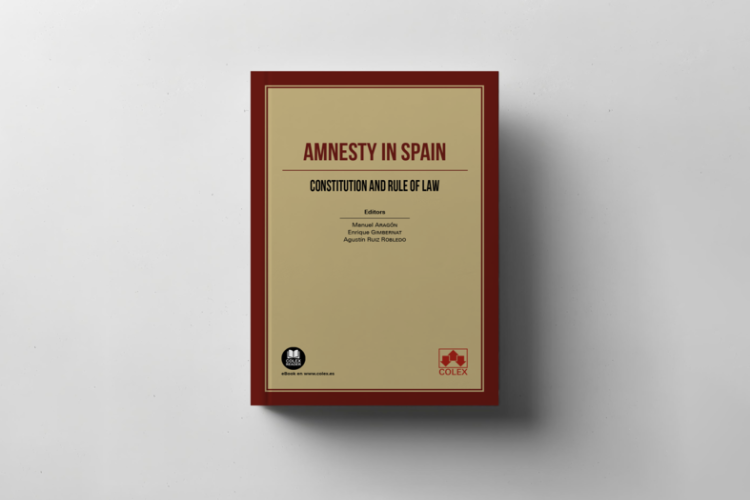
Editorial Colex presents "Amnesty in Spain. Constitution and Rule of Law", a book that addresses the legal and institutional problems of amnesty in Spain from multiple perspectives. Directed by Manuel Aragón, Enrique Gimbernat and Agustín Ruiz Robledo, the work brings together 78 articles (due to the constitutional symbolism of the number) critical of the amnesty arising from the PSOE-Junts pact by authors of recognised prestige.
As the editors point out in the introduction, "any amnesty issued by our constitutional and democratic rule of law violates the Constitution, as its text does not allow it, given that it is an exception to the principle of division of powers that only the Constitution itself can authorise". But even admitting that the Cortes could use its general legislative power to approve an amnesty, there are numerous arguments to explain that the Proposición de Ley Orgánica 122/000019 repeatedly breaches both the Constitution and European law, as this work demonstrates.
Most of the articles collected in this book are updates and reworkings of previous publications in the country's most important print media. "There is great ideological diversity among the authors who consider the amnesty planned by the government distorts the Rule of Law in Spain. Therefore, this book is not written against this or that party or this or that leader or this or that person who has made his or her opinion public. Much less against reconciliation and concord. Nor is it a book against Catalonia, as evidenced by the number of Catalan authors taking part, two of them even writing in their Catalan language. No, this book criticises an amnesty that has no place in the 1978 Constitution, which moreover has been designed here and now as a commercial operation: impunity is exchanged for votes", the editors write in the book.
The genesis of the book responds to a series of concerns expressed by the editors in different media, related to practises that they consider erosive of the Rule of Law, from the excessive use of decree-laws to the politicisation of institutional appointments and regulatory alterations with clear political ends. Concerns that have escalated following the July 2023 elections and the political decisions taken by the incumbent government, particularly about the processing of an amnesty law.
The book is structured in six chapters that make up an index of great thematic diversity: from a general review of the rule of law after the last elections to a detailed analysis of the parliamentarian bill "on amnesty for institutional, political and social normalisation in Catalonia". It also studies the jurisprudential response of the courts to the 1977 amnesty, its consonance with European standards, and deconstructs the arguments put forward in favour of the constitutionality of the amnesty.
All the information on the book "Amnesty in Spain. Constitution and Rule of Law" is available at www.colex.es.
On the trail of success in Spanish
After the successful publication of the Spanish-language book "La Amnistía en España: Constitución y Estado de Derecho", the authors have decided to join forces again to translate their work and make it available to European institutions and, eventually, to the whole world, to shed light on the amnesty debate in Spain.
The presentations made at the Carlos de Amberes Foundation, at the Complutense University in Madrid and at the University of Granada are proof of the interest that Colex's work has aroused in the political, social and academic world.
Editorial Colex
Founded in 1981 by a distinguished group of jurists, Editorial Colex is characterised for being a pioneer in the publication of annotated legal texts. Today, it has established itself as an undisputed benchmark in the sector, thanks to its collection of publications that cover both academic and professional fields, providing more than 500 new works every year. Colex's unwavering commitment to the legal community drives it to offer publications of the highest quality and rigour. Each work reflects in-depth specialisation in various areas of law, guaranteeing readers a reliable and cutting-edge source of knowledge.
Editorial Colex enriches legal and academic practise by offering resources that not only inform, but also inspire and guide legal professionals on their path to excellence.
For further information, please contact the communications department of Editorial Colex ([email protected]).
*To buy the book outside of Spain, you can go to Amazon