
I. Imagen del producto
II. Características técnicas de la obra
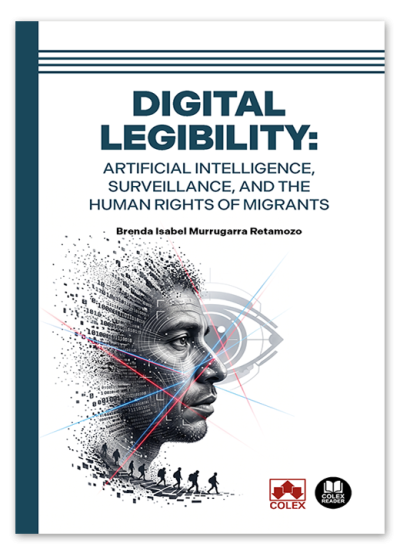
Título | Digital Legibility: Artificial Intelligence, Surveillance, and the Human Rights of Migrants |
F. Publicación | 17/11/2026 |
Colección | biblioteca juridica de bolsillo |
Páginas | 230 |
Formato | PAPEL: 13,5 x 21,5 cm. | ELECTRÓNICO: Conexión a internet necesaria para acceder al eBook - Descarga no permitida |
ISBN (Papel) | 979-13-7065-212-8 |
Autor | Murrugarra Retamozo, Brenda Isabel |
III. Precio y condiciones
P.V.P | ||
Base | I.V.A | Total |
| 19.23 € | Súper reducido | 20.00 € |
IV. Público objetivo de la obra
- Abogados
- Estudiantes de derecho
- Despachos jurídicos
- Opositores
- Academias
- Profesores universitarios
- Personas interesadas en el derecho y/o en su estudio o aplicación
V. Resumen
Digital Legibility: Artificial Intelligence, Surveillance, and the Human Rights of Migrants examines how artificial intelligence has become increasingly involved in the governance of migration. As more decisions pass through digital technologies, personal information acquires growing importance in processes that can shape the future of millions of people. The book explores how this transformation is taking place and what it means for human rights. Through the concept of digital legibility, it considers how migrants come to be understood through information produced about their lives. The book offers a critical reflection on the expanding role of artificial intelligence and on the consequences of interpreting complex human experiences through automated systems.
VI. Sumario de la obra
General Introduction
Book Organization
Chapter 1
Anthropology of Surveillance: Perspectives, Debates, and Contemporary Challenges
Theoretical Framework
From classical surveillance to contemporary forms
Transparency, Participation, and Neoliberal Rationalities
Social worlds, agency, and differential effects
Data Coloniality, Racialization, and New Regimes of Visibility
Methodology
Approach and design
Corpus and selection criteria
Results
Discussion
Conclusions
Chapter 2
Algorithmic Surveillance and Inequality: Digital Legibility, Predictive Control, and Subjectivities in Latin America
Introduction and Theoretical Foundations of Algorithmic Surveillance
Literature Review Methodology
Inclusion criteria
Results
1. Algorithmic surveillance in contexts of inequality
2. Digital precarity and algorithmic vulnerability
3. Digital life, data production, and algorithmic vulnerability
4. Cases regarding digital precarity and algorithmic vulnerability
5. Cases regarding digital precarity and algorithmic vulnerability in Latin America
6. The moral economy of surveillance
7. Algorithmic control and subjectivity
8. Epistemic inequality and digital exclusion
9. Data justice and ethical governance
Final insights from anthropology
Technopolitical resistance and collective agency: the case of the MigrarSinVigilancia (MigrateWithoutSurveillance) Coalition
a) From digital precarity to practices of care
b) Subjectivities, visibility, and agency
c) Disputes regarding the legitimacy of surveillance
d) Data justice and social participation
e) A multiscalar reading of resistance
Conclusions
Chapter 3
Algorithmic Biases and Human Rights: Surveillance, Classification, and Inequality in the Age of AI
Introduction
Theoretical Framework
Algorithms, Artificial Intelligence, and Social Classification
Definition and origin of algorithmic bias
Narrative case study: Invisible Threads: AI, Social Media, and Latin American People on the Move (2025–2026)
Legal and Ethical Perspectives on Algorithmic Bias
Recommendations and strategies for mitigating algorithmic bias
Conclusions
Chapter 4
Platforms, Surveillance, and Artificial Intelligence: Migrant Informational Ecologies
Introduction
Theoretical Framework
Surveillance Capitalism and the Algorithmic Economy
Big Data, prediction, and new forms of social control
Algorithmic moderation, biases, and digital inequalities
Sociopolitical implications: disinformation, deepfakes, and democratic erosion
Ethical and regulatory responses
Methodology
Results and Discussion
a) Transit and digital compasses
b) The lived experience of misinformation
c) Arrival and the exploitation of vulnerabilities
d) Low-cost interventions with measurable effects
A brief anthropological-legal reading of the findings
Conclusion
Chapter 5
Governing through Data: Digital Surveillance and Asylum at the US-Mexico Border
Introduction
How surveillance is experienced: three mediated ethnographic scenes
a) Racialization, visibility, and concealment
b) Automation and digital poverty
c) Deportation as a condition (deportability)
Theoretical Framework
Methodology
Research Design
Corpus and Source Selection
Procedure
Ethical considerations and study limitations
Results
1. Dominant frameworks: security and technological modernization
2. U.S.–Mexico border: technology that redistributes risk
3. Digital governance of asylum: CBP One as digital metering
4. Infrastructure and data: private intermediation and accumulation
5. Asymmetries and harms: who bears the costs
Discussion
Conclusions
Chapter 6
Digital Migration Governance: Artificial Intelligence, Surveillance, and Rights in Latin America and Europe
Introduction and Analytical Framework
The State: Transformation and Power in the Digital Age
State surveillance and digital migration management
Algorithmic bias and exclusion: AI as a mechanism for classifying migrants
Digital rights at risk: privacy, data, and technological surveillance
Ethical and legal regulation: effective protection or a façade of safeguards?
Conclusions
General Conclusion
References