
I. Imagen del producto
II. Características técnicas de la obra
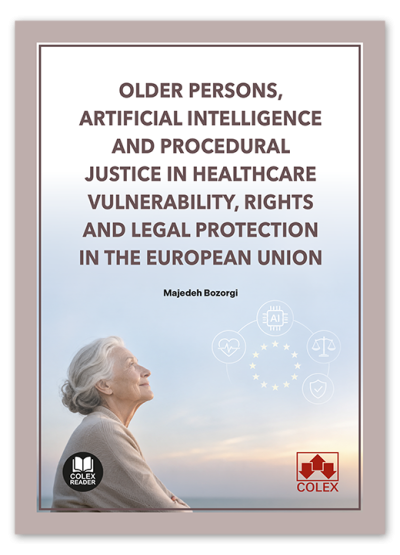
Título | Older persons, artificial intelligence and procedural justice in healthcare vulnerability, rights and legal protection in the European Union |
F. Publicación | 10/11/2026 |
Colección | monografico |
Páginas | 310 |
Formato | PAPEL: 17 x 24 cm. | ELECTRÓNICO: Conexión a internet necesaria para acceder al eBook - Descarga no permitida |
ISBN (Papel) | 979-13-7065-206-7 |
Autor | Bozorgi, Majedeh |
III. Precio y condiciones
P.V.P | ||
Base | I.V.A | Total |
| 28.85 € | Súper reducido | 30.00 € |
IV. Público objetivo de la obra
- Abogados
- Estudiantes de derecho
- Despachos jurídicos
- Opositores
- Academias
- Profesores universitarios
- Personas interesadas en el derecho y/o en su estudio o aplicación
V. Resumen
Population ageing and the growing use of artificial intelligence in healthcare raise important questions about fundamental rights, vulnerability, and access to justice. This book examines the legal challenges facing older persons in increasingly digital healthcare systems, focusing on autonomy, informed consent, privacy, discrimination, and accountability.
Drawing on European Union law and a comparative legal perspective, the study explores the relationship between healthcare regulation, artificial intelligence governance, and procedural justice. It examines how technological innovation may reinforce existing inequalities and why traditional legal protections may prove insufficient for older patients.
Particular attention is given to structural vulnerability, age-related discrimination, human oversight, and the right to challenge decisions influenced by algorithmic systems. The book argues that recognising fundamental rights is not enough unless effective procedural safeguards make those rights enforceable.
By connecting the protection of older persons with emerging European legal frameworks, this monograph contributes to debates on human dignity, healthcare rights, and accountable artificial intelligence.
DOI: https://doi.org/10.69592/979-13-7065-206-7
VI. Sumario de la obra
Acknowledgements
Acknowledgements
Introduction
Introduction
Part I
Foundations: Older Persons, Healthcare, and Artificial Intelligence
Chapter 1
The Rights of Older Persons: Historical and Legal Foundations
1.1 Ageing as a Global Transformation
1.2 The Historical Status of Older Persons
1.3 The Vienna Plan and the Emergence of an International Framework
1.4 Madrid, the ILO, and the Turn Toward Development
1.5 The Foundations of Elder Rights
1.6 Guiding Principles and Conclusion
Chapter 2
Artificial Intelligence in Healthcare and Elder Care
2.1 The Origins and Character of Medical Artificial Intelligence
2.2 Applications and Limits in Clinical Practice
2.3 Artificial Intelligence and the Ageing Population
2.4 Digital Literacy and the Emergence of the Grey Digital Divide
2.5 The Legal Status of Digital Literacy and the Obligations of States
2.6 Ageism in Design and the Limits of Technological Promise
Chapter 3
Vulnerability, Dignity, and the Limits of Existing Legal Protection
3.1 Vulnerability as a Legal Category
3.2 Victimisation, Power, and the Silent Victim
3.3 Double Vulnerability and the Consequences of Victimisation
3.4 Access to Justice as the Guarantee of All Other Rights
3.5 A Model of Enforceable Protection: The Texas Statutory Scheme
3.6 The Limits of Existing Protection in Technologically Mediated Care
Chapter 4
Ageing Policy and Care Models: International Perspectives
4.1 From Institutional Care to Integration: The Shift in Policy Direction
4.2 Care Models: Family-Centred, Self-Care, and Daily Care
4.3 The Long-Term Care System as an International Standard
4.4 National Systems: The United Kingdom, Japan, and Italy
4.5 National Systems: Spain, Germany, Turkey, Iran, and the Gulf States
4.6 Volunteering, Participation, and the American and Swedish Models
Part II
Procedural Justice and the Regulation of AI in Elder Care
Chapter 5
Justice, Procedure, and Artificial Intelligence
5.1 The Regulatory Vacuum
5.2 Legal Personality, Liability, and the Attribution Problem
5.3 Data Protection as a Procedural Guarantee
5.4 Transparency as a Legal Principle
5.5 Two Case Studies in Procedural Failure
5.6 Justice, Equity, and Algorithmic Bias
5.7 Trustworthy Artificial Intelligence and the Limits of Guidance
Chapter 6
International and National Legal Guarantees for Older Persons
6.1 Procedural Law as an Instrument of Substantive Equality
6.2 The International Framework
6.3 The OECD Recommendation and Automated Decisions
6.4 Constitutional and Statutory Guarantees in Spanish Law
6.5 Jurisprudential Development: European and Constitutional Courts
6.6 The Limits of Judicial Treatment of Automated Decisions
Chapter 7
The European Union’s Regulatory Framework for AI in Healthcare
7.1 From Soft Law to Binding Regulation
7.2 The Artificial Intelligence Act: Structure and Obligations
7.3 The Wider Regulatory Ecosystem: Data, Devices, and Research
7.4 Interoperability, Product Safety, and Cybersecurity
7.5 Three Layers of Transparency and the Limits of Explanation
7.6 Human Rights Instruments and National Complements
7.7 Assessment: What the Framework Delivers for Older Persons
Chapter 8
Liability, Accountability, and Legal Responsibility in AI-Assisted Care
8.1 The Attribution Problem Restated
8.2 Product Liability, Fault, and the Human Override
8.3 The Spanish Approach: Evidentiary Standards and the Burden of Proof
8.4 The Absence of Judicial Treatment of Algorithmic Harm
8.5 What an Adequate Liability Framework Requires
Part III
The Spanish Case
Chapter 9
The Spanish Case: Healthcare, Ageing, and Artificial Intelligence
9.1 Why a Single National System
9.2 Structure and Principles of the National Health System
9.3 Governance, Financing, and Service Provision
9.4 Demographic Ageing and Provision for Older Persons
9.5 Artificial Intelligence in Diagnosis and Everyday Support
9.6 Evidence from Spanish Practice
9.7 The Regulatory Framework and Its Ethical Demands
Part IV
Toward Reform
Chapter 10
Age-Sensitive Procedural Law
10.1 The Case for a New Framework
10.2 Accessibility as a Procedural Requirement
10.3 The Digital Ombudsman
10.4 Algorithmic Opacity as a Procedural Defect
10.5 Soft Law as a Source of Procedural Innovation
10.6 From Ethical Principle to Enforceable Standard
10.7 Procedural Law as Proactive Governance
Chapter 11
Conclusions
11.1 The Disconnect Between Algorithmic Decision-Making and Procedural Protection
11.2 What the Argument Establishes and What It Does Not
11.3 The Principal Contributions
11.4 Procedural Law as an Instrument of Equity
11.5 The Argument in Summary
11.6 Final Observations
References
International Instruments and Treaties (Introduction and Chapters 1–4)
National Legislation and Case Law (Introduction and Chapters 1–4)
International and European Instruments (Chapters 5–11)
National Legislation, Case Law, and Policy Instruments (Chapters 5–11)