
I. Imagen del producto
II. Características técnicas de la obra
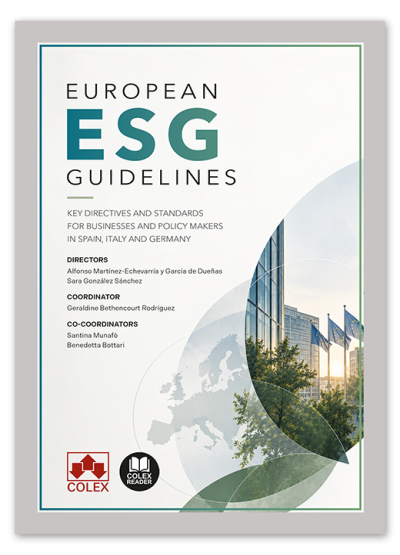
Título | European ESG Guidelines |
Subtítulo | Key directives and standards for businesses and policy makers in Spain, Italy and Germany |
F. Publicación | 18/11/2026 |
Colección | monografico |
Páginas | 144 |
Formato | PAPEL: 17 x 24 cm. | ELECTRÓNICO: Conexión a internet necesaria para acceder al eBook - Descarga no permitida |
ISBN (Papel) | 979-13-7065-076-6 |
Autor | V.V.A.A |
III. Precio y condiciones
P.V.P | ||
Base | I.V.A | Total |
| 14.42 € | Súper reducido | 15.00 € |
IV. Público objetivo de la obra
- Abogados
- Estudiantes de derecho
- Despachos jurídicos
- Opositores
- Academias
- Profesores universitarios
- Personas interesadas en el derecho y/o en su estudio o aplicación
V. Resumen
This guide provides a comprehensive analysis of the evolving Environmental, Social and Governance (ESG) regulatory framework of the European Union and its implementation in Spain, Italy and Germany. It examines the legal and economic architecture underpinning European sustainability policy. The document explains the core principles governing the European ESG model, including transparency, stakeholder engagement, standardization, due diligence, double materiality and anti-greenwashing measures.
Using a comparative legal, economic and policy approach, the guidelines assess national constitutional foundations, sectoral regulations and governance mechanisms in Spain, Italy and Germany, highlighting convergences and regulatory specificities. The study further translates legal requirements into operational recommendations for enterprises and public administrations, covering ESG governance, sustainability reporting, climate transition planning, activity-chain due diligence, public procurement and digital transformation.
The publication concludes by identifying key challenges for European policymakers, including regulatory complexity, SME adaptation, data quality and institutional capacity, while emphasizing opportunities linked to sustainable finance, innovation, digitalization and human capital development. Overall, the guide positions ESG not merely as a compliance framework but as a strategic instrument for enhancing competitiveness, resilience and sustainable growth within the European Union.
DOI: https://doi.org/10.69592/979-13-7065-076-6
VI. Sumario de la obra
1. Introduction: what BEYOND is
Alfonso Martínez-Echevarría y García de Dueñas
Universidad San Pablo-CEU, CEU Universities
Sara González Sánchez
Universidad Cardenal Herrera-CEU, CEU Universities
2. Objectives of this guide and target audience
Alfonso Martínez-Echevarría y García de Dueñas
Universidad San Pablo-CEU, CEU Universities
Sara González Sánchez
Universidad Cardenal Herrera-CEU, CEU Universities
3. European Union ESG regulatory architecture
Alfonso Martínez-Echevarría y García de Dueñas
Universidad San Pablo-CEU, CEU Universities
Sara González Sánchez
Universidad Cardenal Herrera-CEU, CEU Universities
3.1. European ESG Key Principles and Standards
Alfonso Martínez-Echevarría y García de Dueñas
Universidad San Pablo-CEU, CEU Universities
Sara González Sánchez
Universidad Cardenal Herrera-CEU, CEU Universities
3.1.1. Transparency and Disclosure
3.1.2. Stakeholder Engagement
3.1.3. Standardization and Verification
3.1.4. Due Diligence
3.1.5. Progressiveness and Phased Rollout
3.1.6. Double Materiality
3.1.7. Sector-Specific Guidance
3.1.8. Tackling Greenwashing
3.2. European Union ESG Regulatory Framework
Alfonso Martínez-Echevarría y García de Dueñas
Universidad San Pablo-CEU, CEU Universities
Sara González Sánchez
Universidad Cardenal Herrera-CEU, CEU Universities
3.2.1. Current European Regulation
3.2.2. Key European Regulatory Projects
4. European ESG guidelines in Spain, Italy and Germany
4.1. Spanish ESG guidelines
Alfonso Martínez-Echevarría y García de Dueñas
Universidad San Pablo-CEU, CEU Universities
Sara González Sánchez
Universidad Cardenal Herrera-CEU, CEU Universities
4.1.1. Spanish ESG Key Features
4.1.1.1. From Environmental Sustainability to ESG
4.1.1.2. Integration of ESG and Spanish Market Actors as Key Addressees
4.1.1.3. Types of Market Actors in Spain as Main ESG Addressees
4.1.1.4. ESG and Public Administration in Spain
4.1.2. Spanish ESG Regulatory Framework
4.1.2.1. Current Spanish Regulation
4.1.2.1.1. ESG Overview in Spanish Legislation
4.1.2.1.2. ESG Spanish Regulation Across Sectors
4.1.2.1.2.1. Corporations and Corporate Governance
4.1.2.1.2.2. Financial Market
4.1.2.1.2.3. Credit Market
4.1.2.1.2.4. Carbon Market
4.1.2.1.2.5. Public Administration
4.1.2.2. Key Spanish Regulatory Projects
4.2. Italian ESG regulatory framework
Gabriella Iermano
University of Pisa
Maria Cristina Quirici
University of Pisa
Luca Spataro
University of Pisa
4.2.1. Italian ESG Key Features
4.2.1.1. From Environmental Sustainability to ESG
4.2.1.2. Integration of ESG and Italian Market Actors as Key Addressees
4.2.1.3. Types of Market Actors in Italy as Main ESG Addressees
4.2.1.4. ESG and Public Administration in Italy
4.2.2. Current Italian ESG Regulatory Framework
4.2.2.1. ESG Overview in Italian Legislation
4.2.2.2. Constitutional Foundations of Sustainability and ESG in Italy
4.2.2.3. Recent Italian Initiatives Boosting ESG Values
4.2.2.4. ESG Italian Regulation Across Sectors
4.2.2.4.1. Corporations and Corporate Governance
4.2.2.4.2. Financial Market
4.2.2.4.3. Credit Market
4.2.2.4.4. Carbon Market
4.2.2.4.5. Public Administration
4.2.3. Italian ESG Regulatory Developments and Future Perspectives
4.3. German ESG regulatory framework
Anka Reich
HfWU Nürtingen-Geislingen University, Germany
Claudia Stachel
HfWU Nürtingen-Geislingen University, Germany
4.3.1. Constitutional Foundations and Guiding Principles
4.3.1.1. Article 20a of the Basic Law and the Ecological State Objective
4.3.1.2. Fundamental Rights and Social Sustainability
4.3.1.3. Equality Policies and Gender Quotas
4.3.1.4. Climate Protection Jurisprudence of the Federal Constitutional Court
4.3.2. Environmental Regulation and Climate Targets
4.3.2.1. Federal Climate Protection Act and National Climate Targets
4.3.2.2. Other Key Environmental Laws
4.3.3. Social ESG Regulation and Supply Chain Responsibility
4.3.4. Relevance for Different Groups of Actors
4.3.5. ESG Regulation Across Sectors
4.3.5.1. Corporations and Corporate Governance
4.3.5.2. Financial Market
4.3.5.3. Credit Market
4.3.5.4. Carbon Market
4.3.6. Overall Assessment
4.4. Comparative Snapshot: Spain, Italy and Germany
Alfonso Martínez-Echevarría y García de Dueñas
Universidad San Pablo-CEU, CEU Universities
Sara González Sánchez
Universidad Cardenal Herrera-CEU, CEU Universities
5. Operational ESG Guidelines
5.1. Operational guidelines for enterprises in the European regulatory environment
Frank Andreas Schittenhelm
HfWU Nürtingen-Geislingen University, Germany
Gabriella Iermano
University of Pisa
5.1.1. Guideline 1 – Establish a Double Materiality Framework
5.1.2. Guideline 2 – Build ESG Data Infrastructure
5.1.3. Guideline 3 – Implement Supply Chain Due Diligence
5.1.4. Guideline 4 - Adopt a Climate Transition Plan
5.1.5. Guideline 5 - Establish ESG Governance and Board-Level Accountability
5.1.6. Guideline 6 - Secure Strategic ESG Positioning
5.1.7. Summary: Operational ESG Obligations for Enterprises at a Glance
5.2. Operational ESG Guidelines for Public Administration
Luca Spataro
University of Pisa
Maria Cristina Quirici
University of Pisa
5.2.1. Operational Guideline 1 – Integrating ESG into Strategic Planning
5.2.2. Operational Guideline 2 – Establishing Effective ESG Governance
5.2.3. Operational Guideline 3 – Promoting Sustainable Public Procurement
5.2.4. Operational Guideline 4 – Measuring, Reporting and Improving ESG Performance
5.2.5. Operational Guideline 5 – Strengthening Stakeholder Engagement
5.2.6. Operational Guideline 6 – Leveraging Digital Transformation and Artificial Intelligence
5.2.7. Key Success Factors for ESG Implementation within Public Administration and Enterprises
5.2.8. BEYOND. ESG Awareness among European Youth
Dario Latella
University of Messina
Co- coordinators:
Santina Munafò and Benedetta Bottari
University of Messina
5.2.8.1. The strategic context: why BEYOND is necessary
5.2.8.2. The European regulatory architecture
5.2.8.3. The gap and the objectives of the project
5.2.8.4. Research design and psychometric properties
5.2.8.5. Profile of respondents
5.2.8.6. ESG awareness and the three pillars
5.2.8.7. Sources of knowledge, barriers and educational channels
5.2.8.8. ESG and the corporate world
5.2.8.9. ESG and individual choices: building moral capital
5.2.8.10. EU ESG policies and civic engagement
5.2.8.11. ESG knowledge and professional prospects
5.2.8.12. Concluding remarks
5.2.8.13. Sources
5.2.9. Report on the survey. Understanding and Enhancing ESG Awareness among European Youth
Dario Latella
University of Messina
Co- coordinators:
Santina Munafò and Benedetta Bottari
University of Messina
5.2.9.1. Executive Summary – Understanding and Enhancing ESG Awareness among European Youth
5.2.9.2. Report on the survey. Understanding and Enhancing ESG Awareness among European Youth
5.2.9.2.1. Demographic and Geographic Profile
5.2.9.2.2. ESG Awareness among Respondents
5.2.9.2.3. Recognition of ESG Principles and Indicators
5.2.9.2.4. ESG Training: Challenges and Solutions
5.2.9.2.5. Insights on EU ESG Policies and its Implications
5.2.9.2.6. Survey Analysis: Consistency and Reliability
6. European ESG Challenges and opportunities for policymakers
Luca Spataro
University of Pisa
6.1. The evolving context
6.2. Key Challenges for European Policymakers
6.3. Policy Priorities and Opportunities
6.4. Policy Recommendations
6.5. Concluding Remarks