Editorial Colex S.L.
910 600 164
info@colex.es

I. Imagen del producto
II. Características técnicas de la obra
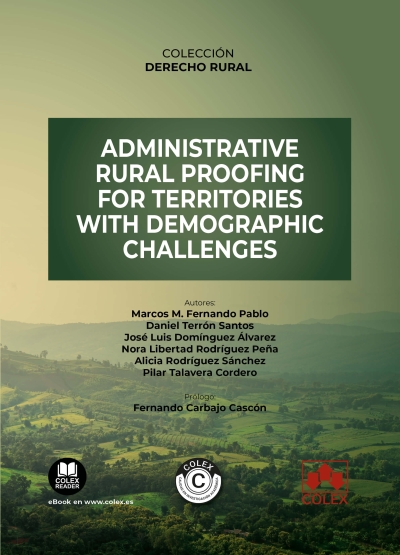
Título | Administrative rural proofing for territories with demographic challenges |
Subtítulo | COLECCIÓN DERECHO RURAL |
F. Publicación | 22/05/2024 |
Colección | monografico |
Páginas | 222 |
Formato | PAPEL: 17 x 24 cm.| ELECTRÓNICO: Conexión a internet necesaria para acceder al eBook |
ISBN (Papel) | 978-84-1194-500-4 |
Autor | V.V.A.A |
III. Precio y condiciones
P.V.P | ||
Base | I.V.A | Total |
| 24.04 € | Súper reducido | 25.00 € |
IV. Público objetivo de la obra
- Abogados
- Estudiantes de derecho
- Despachos jurídicos
- Opositores
- Academias
- Profesores universitarios
- Personas interesadas en el derecho y/o en su estudio o aplicación
V. Resumen
Accede a la COLECCIÓN COMPLETA pinchando aquí
Since the issue of the abandonment of rural territories has been reintroduced into the agenda of national and European public policies, decisions and rules have been made with an aim that seem to be leading to an entrenchment of the conflict between the interests of the population that remains in the forgotten areas and the interests of other policies that are strongly anchored in long-term strategies.
The rules in which these strategic decisions are translated clash with territories and communities on which a decrease or a set of rules is imposed that makes it impossible for traditional activities to develop and adapt to the new times.
In this context, the citizens of remote (or, in popular Spanish terminology, ‘empty’) areas, who observe how other interests prevail over their demands, are confronted with a tide of ‘alien’ rules, imposed, experienced as ‘impositions’ that necessarily generate conflict, just when it seemed that positive discrimination in favour of their particular conditions would have been passed in the context of the ‘European long-term strategy for rural areas’.
Against this backdrop, this collective work aims to provide an study of some of these conflicts, to balance the particular interests of rural territories with the major strategic objectives that mark the institutional agenda, and to vindicate the importance of orienting the actions of public authorities towards the ever necessary restoration of the dignity of rural communities.
VI. Sumario de la obra
PROLOGUE
Fernando Carbajo Cascón
Chapter I
Legislative and institutional reforms to address the demographic and territorial challenge: a global perspective
José Luis Domínguez Álvarez
I.THE DEMOGRAPHIC AND TERRITORIAL CHALLENGE: TRACES OF A PUBLIC POLICY UNDER CONSTRUCTION AND AN INCIPIENT OBJECT OF NORMATIVE REGULATION
II.RETHINKING LAWMAKING AND BETTER REGULATION FOR LEGAL CERTAINTY: THE IMPORTANCE OF REGULATORY IMPACT ANALYSIS
III.ADVANTAGES AND OPPORTUNITIES OF INCLUDING THE DEMOGRAPHIC AND TERRITORIAL DIMENSION IN THE REGULATORY IMPACT ASSESSMENT REPORT
IV.SOME REFLECTIONS ON THE RECENT EMERGENCE OF THE RURAL GUARANTEE SCHEME
V.CONCLUSIONS
VI.BIBLIOGRAPHY
Chapter II
General laws and territorial government in rural areas: the Kingdom of Spain
Marcos M. Fernando Pablo
I. A LONG-TERM VISION FOR RURAL AREAS
II. PRICE AND VALUE: TERRITORY IN SPAIN
III. THE INEQUALITY HIDDEN IN THE GENERALITY OF THE LAW
IV. TERRITORIAL GOVERNANCE FOR RURAL AREAS
V. CONCLUSIONS
VI. BIBLIOGRAPHY
Chapter III
Demographic challenge and renewable energies: is Spain an example for Europe?
Daniel Terrón Santos
I. INTRODUCTION
II. REGULATION OF RENEWABLE ENERGIES AND THE IMPACT OF THEIR PROMOTION IN RURAL AREAS
III. SOCIAL LICENCE TO OPERATE
IV. CONCLUSIONS
V. BIBLIOGRAPHY
Chapter IV
A rural proofing mechanism to enhance special financial and taxation policies in areas with demographic singularities: the case of Castile and Leon
Nora Libertad Rodríguez Peña
I. INTRODUCTION: TERRITORIAL SINGULARITIES AS A DETERMINING FACTOR IN THE ADOPTION OF DIFFERENTIATED FINANCIAL AND TAXATION POLICIES
II. THE DEMOGRAPHIC AND TERRITORIAL CHALLENGE IN SPAIN AS A DESTABILISING FACTOR OF THE WELFARE STATE: SPECIAL REFERENCE TO THE PARTICULARITIES OF CASTILE AND LEON
III. APPLICATION OF RURAL PROOFING TO CASTILE AND LEON TAX LEGISLATION AND TO SPANISH REGIONAL FINANCING
IV. FINAL REFLECTIONS
V. BIBLIOGRAPHY
Chapter V
Security management in rural areas with demographic challenges: analysis of public crime prevention policies
from the perspective of formal social control
Alicia Rodríguez Sánchez
I. INTRODUCTION
II. SPECIAL SECURITY PROTECTION AND GUARANTEE OF PREVENTION
III. PREVENTION AS A POLICY IN FAVOUR OF SECURITY THROUGH FORMAL SOCIAL CONTROL
IV. RURAL SECURITY ON THE PUBLIC AUTHORITIES’ ROADMAP
V. FORMAL SOCIAL CONTROL OF THE POLICE IN RURAL AREAS AS A GUARANTOR OF SECURITY
VI. CONCLUDING REFLECTIONS. THE LACK OF DATA AN INSURMOUNTABLE GAP FOR EFFECTIVE CONCLUSIONS
VII. BIBLIOGRAPHY
VIII. ANNEX
Chapter VI
Agri-food sector and rural environment
Pilar Talavera Cordero
I. INTRODUCTION
II. THE AGRI-FOOD SECTOR AND THE EU
III. THE COMMON AGRICULTURAL POLICY (CAP)
IV. FOOD CHAIN LAW
V. SHORT SUPPLY CHAINS
VI. CONCLUSION
VII. BIBLIOGRAPHY