Editorial Colex S.L.
910 600 164
info@colex.es

I. Imagen del producto
II. Características técnicas de la obra
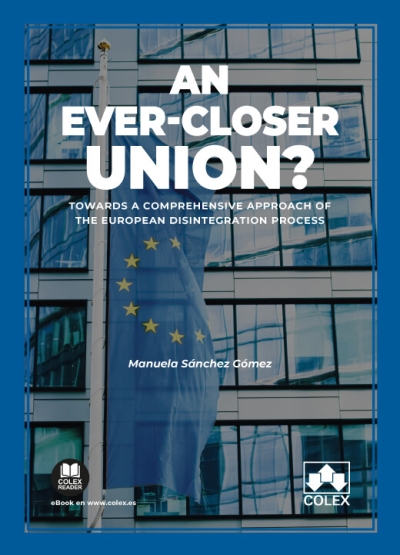
Título | An ever-closer Union? |
Subtítulo | Towards a comprehensive approach of the european disintegration process |
F. Publicación | 14/12/2023 |
Colección | monografico |
Páginas | 258 |
Formato | PAPEL: 17 x 24 cm. | ELECTRÓNICO: Conexión a internet necesaria para acceder al eBook - Descarga no permitida |
ISBN (Papel) | 978-84-1194-219-5 |
Autor | Sánchez Gómez, Manuela |
III. Precio y condiciones
P.V.P | ||
Base | I.V.A | Total |
| 24.04 € | Súper reducido | 25.00 € |
IV. Público objetivo de la obra
- Abogados
- Estudiantes de derecho
- Despachos jurídicos
- Opositores
- Academias
- Profesores universitarios
- Personas interesadas en el derecho y/o en su estudio o aplicación
V. Resumen
The EU was created with the aim of promoting an ever-closer union among the peoples of Europe. For decades, the European project has been consolidated to the extent that new countries have joined the EU and its supranational governance areas have been gradually increasing. In the period between 2010 and 2020, the context changed drastically. In that period there have been crises that differ from all the previous ones that have jeopardized the European integration process. Despite decades of research in the field of European integration, as of the date of writing this book, academic studies assessing European disintegration are profoundly scarce. This investigation addresses, from the perspective of public international law, the consequences of the eurozone crisis, migration crisis, Brexit, and the war in Ukraine to shed light on whether there have been any signs of European disintegration and provide readers with a set of explanatory factors that show different results for each crisis.
VI. Sumario de la obra
ABBREVIATIONS
A PRELIMINARY NOTE
ABSTRACT
INTRODUCTION
1. Aims and research topic
2. Contribution to current research
3. Theoretical approximation towards European disintegration
4. Structure of the book and research design
CHAPTER I
THE IMPACT OF THE EUROZONE CRISIS ON THE EUROPEAN INTEGRATION PROCESS
1. Introduction
2. Regulatory, political and economic context
3. Main features of the renewed economic governance of the EU
4. Consequences of the eurozone crisis in relation to the integration process
5. Explanatory factors
6. Underlying implications for the EU
7. Conclusions
CHAPTER II
THE IMPACT OF THE MIGRATION CRISIS ON THE EUROPEAN INTEGRATION PROCESS
1. Introduction
2. Regulatory and jurisprudential framework
3. Social and political context
4. Consequences of the refugee crisis in relation to the integration process
5. Explanatory factors
6. Underlying implications for the EU
7. Conclusions
CHAPTER III
THE IMPACT OF UK WITHDRAWAL ON THE EUROPEAN INTEGRATION PROCESS
1. Introduction
2. Regulatory, political, and social context
3. Negotiations on the withdrawal of the UK (2017–2020)
4. Consequences of Brexit in relation to the integration process
5. Explanatory factors
6. Underlying implications for the EU
7. Conclusions
CHAPTER IV
THE IMPACT OF THE UKRAINE WAR ON THE EUROPEAN INTEGRATION PROCESS
1. Introduction
2. EU response to Russia’s invasion of Ukraine
3. Consequences of the Ukraine war crisis in relation to the integration process
4. Explanatory factors
5. Underlying implications for the EU
6. Conclusions
CONCLUSIONS
1. Most relevant findings of the eurozone, migration and Brexit crisis regarding the EU disintegration process
2. Explanatory factors in comparative perspective: similarities and differences between crises
3. European disintegration process: reflections on uncertain scenarios
REFERENCES
Bibliography
Documentary index